


News
Keep a finger on the pulse
7 Oct 2026



From faster scans and safer navigation for emergency aircraft to better healthcare spaces and shorter waits for heart surgery, these leaders are improving vital services and helping save lives.
For many businesses represented in The LDC Top 50, success is measured by more than balance sheets – it’s marked by how much their leaders can change the world for the better. In some cases, this even means helping to save lives.
Rachel Beverley-Stevenson’s drive to improve people’s health is rooted in personal experience. Losing her brother when he was 23 helped shape her outlook and determination to make a difference.

I see the impact we are having on people’s lives and it gives me energy.”
She co-founded Leeds-based OneMedical Group with her father, Michael, with a purpose of creating “a healthier future for all.” Initially developing medical buildings around patients and staff, the business moved into primary care in 2006 and today it delivers GP and urgent care services for the NHS through OneMedicare.
Her sense of purpose led Beverley-Stevenson to introduce a patient education model in 2012 to help people access wider support and manage their own health. It has since evolved into wellbeing services focused on addressing health inequalities in local communities.
Beverley-Stevenson now wants to extend that approach with the launch of OnePreciousLife, a new health service initially focused on women’s health, and a charitable foundation that will use group profits to fund community health programmes.
For Dr. Anil Ohri, the challenge was a shortage of NHS specialist cardiac capacity. In 2002, the Army and NHS surgeon left frontline medicine to start Regent’s Park Healthcare, aiming to bridge the gap between supply and demand. “I wanted to make a difference,” he says. “Instead of doing that one patient at a time, I realised I could do it at scale.”
Starting as a mobile service, or “cardiac factory on wheels,” and operating in hospital car parks, Dr. Ohri and his team have added modular theatres and clinics, helping NHS trusts increase cardiac capacity and reduce waiting lists.
His mantra from day one has been to find a better partnership model with the NHS, to develop a service based on specialisation in one area. “Doing one thing means you can do it really well because you understand the nuances,” he says. “My ambition has always been to create something scalable that helps society.”
Airbox Systems grew from William Moore’s concern that existing navigation technology was not suited to the demands of UK emergency aviation. After learning to fly in 2005, he realised that “navigation systems were imported from the US but the way Americans fly is different because they have so much space”. He explains: “Those systems weren’t good for flying here. I thought: ‘I can do better than this.’”
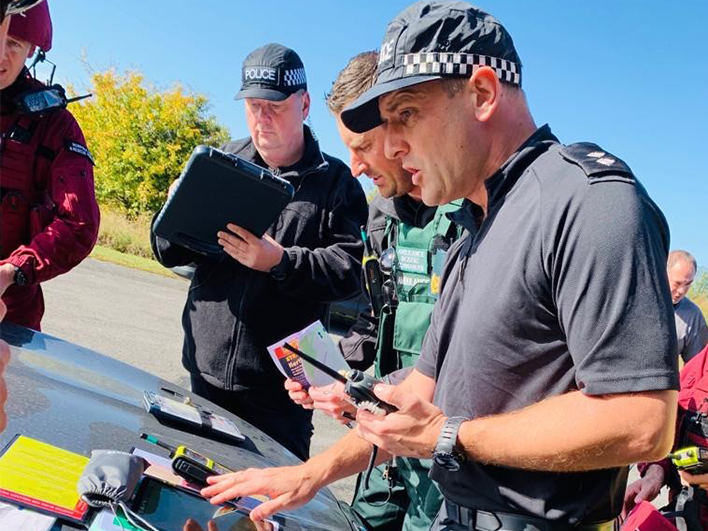
Moore started developing what would become Airbox Systems, specialising in operational information-sharing software for emergency services. His initial focus was on air ambulances.
He believed technology could reduce some of the risks associated with emergency aviation. The challenge, he recalls, was: “How could they get on and off the ground quickly, navigate safely at low levels and avoid power lines?”
Moore adapted technology available from the likes of Google to improve pilots’ situational awareness and help them make decisions during emergencies. By 2018, UK air ambulances, police and other aircraft were using Airbox. “Every country needs a digital ecosystem where emergency responders can share information with anyone in the network in real time,” he says. “If you do this, you can change outcomes.”
For Mohammed and Bushra Sheikh, combining the power of AI with a human touch allows them to help more patients through PHP, their Leicester-based online pharmacy, which delivers medication directly to people’s doors. “We get thousands of prescriptions in the post, some handwritten, some printed,” Mohammed says. “Normally someone would need to go through these manually but we developed an AI tool to scan, read and prioritise those that need processing straight away.”
Getting through requests at scale is PHP’s superpower, but it is underpinned by people who truly care. Understanding that people’s needs sometimes extend beyond delivery of drugs, PHP offers usage videos, storage guidance and real-time updates. “We take things personally – sometimes I can’t read the emails because I get too emotionally involved and want to help people outside of our remit,” says Bushra. “Our customers see our dedication.”
Healthy dose of disruption
Old assumptions are getting a rethink in dentistry, social care and ambulance technology.
Many of The LDC Top 50’s leaders are shaking up long-established sectors with innovative ideas.
Kunal Thakker has a fresh take on dentistry, having conceived of a clinic that “didn’t look or feel like a dental practice”. At Tooth Club, patients can book evening and Saturday appointments, and watch Netflix during treatment. “People don’t want to go to the dentist during the working day,” Thakker says.
It’s an offering that has proved popular. Since launching in 2020, Tooth Club has grown into a chain with 19 sites.
Thakker also recruits and trains people from outside dentistry, believing they are less constrained by established practices. “We start from scratch and allow people to fail – you come out stronger,” he says.
Richard Dooner, chief executive of Birmingham-based Antser Group, believes health and social care is ripe for change. He has used immersive virtual reality to train teachers, social workers and police officers to deal with scenarios involving drug misuse, child grooming and knife crime.
The results have been striking. In one focus group, six of ten teenagers aged 13-18 said they might carry a knife; after the VR experience, none said they would.
When asked what drives his pioneering spirit, Dooner says he is motivated by a determination not to let others down.
I don’t want to fail myself, the people that work for me, or all the beneficiaries of the things that we do.”
For Emma Strain, joint managing director of CSS Europe, innovation in emergency care carries particularly high stakes. At the London Ambulance Service, for example, CSS is integrating RFID technology to quickly check that vital equipment is on board ambulances, alongside real-time asset management and automated vehicle preparation.
True transformation involves looking beyond the products’ selling points to measurable results, according to Strain.
“We see so many software houses sell a dream that never comes to fruition,” she says. “I’ve always been very passionate about ensuring that what we’re selling is the right thing for the right people.
We never say it will give you something without providing the data to support it. We really care.”
