


News
Leading through change: powering the future of healthcare
3 Jul 2026



This content was originally featured in our Healthcare Sector report.
From clinical diagnostics to occupational health, healthcare businesses today are operating in a fast-evolving environment. Technological change, workforce shortages and funding challenges are reshaping the sector – but for businesses with the right partner, there is real potential for growth.
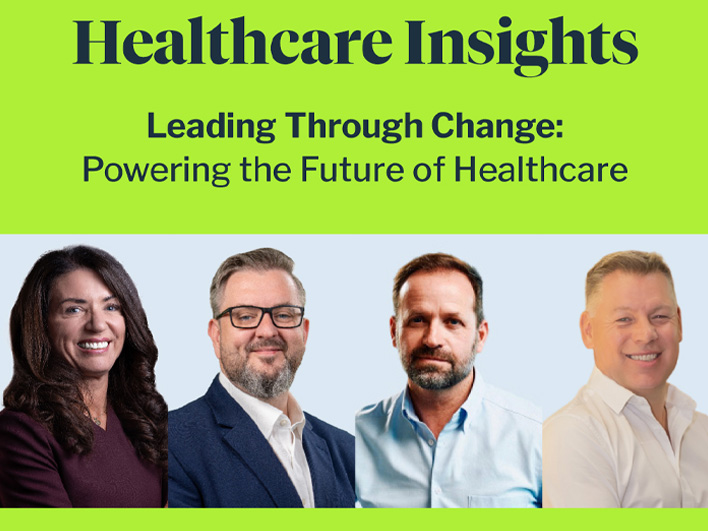
In this roundtable, four CEOs from our healthcare portfolio – Siobhan Crowley of Medray Group, Chris Rigg of PAM Group, Simon Estcourt of TMC Pharma Services and David Cahill of RDi – reflect on innovation, ESG and how private equity is helping them to achieve their ambitions.
What does it take to grow a healthcare business today?
In a system under pressure, healthcare businesses are playing an increasingly vital role – not only in relieving strain on public services, but in driving innovation and improving outcomes. “The burden of a healthy workforce is increasingly falling on employers,” says Chris. “With an ageing population, NHS backlogs and rising absenteeism, private businesses are having to step up. That’s a challenge – but also a major opportunity.”
PAM Group, one of the UK and Ireland’s leading providers of occupational health and wellbeing services, supports more than 1,000 organisations. “Absenteeism costs the UK billions of pounds a year, and there are 34 million working days lost due to injuries,” Chris adds. “If you’re not on top of employee health, your business suffers. That’s why demand is growing – and why we need to grow with it.” To meet that demand, many leaders are turning to private equity to help them scale with purpose.
Medray Group, a leading diagnostic imaging provider headquartered in Ireland, continues to expand its presence across the UK and mainland Europe. Last year, the business secured private equity investment to support its strategic growth ambitions. “While we had already established a foothold in the UK, it was clear we needed a partner who could help to drive long-term, sustainable growth. LDC’s healthcare experience and their alignment with our vision made them the ideal choice. The LDC team made a great first – and lasting impression. It was clear they were aligned with our business model and understood how it could grow.” says Siobhan.
For David at RDi, a market leader in data driven, automated self sampling kits for healthcare, M&A has become a key lever for scaling the business. “Earlier this year, RDi acquired AI business Inicio Health as a strategic step that immediately expanded our technological capabilities. The acquisition enables us to offer a comprehensive digital healthcare solution that accelerates our mission of making healthcare more accessible, efficient and patient-centric.”

We needed a partner who could help to drive long-term, sustainable growth. LDC’s healthcare experience made them the ideal choice."
How are businesses using technology and AI?
All four CEOs are exploring how technology can unlock smarter, more scalable services – from clinical reporting to operational efficiency. “We’re piloting AI-generated clinician reports,” says Chris. “If we can reduce admin burdens, our clinicians can see more patients – and ultimately that improves outcomes and productivity.” David echoes the importance of operational efficiency. “We’ve invested in automation to handle complex tasks more efficiently – and it’s helping us to scale without compromising on quality.”
TMC Pharma Services (TMC), a global research organisation that provides a full range of expert pharma and biotech support services for rare conditions and diseases, is also embracing digital transformation. “In the US, the FDA doesn’t yet have a framework to fully trust AI in clinical development,” says Simon. “But across operations, from documentation to marketing, AI is already streamlining how we work.” Siobhan adds that LDC’s strategic input has been instrumental. “The planning sessions we’ve had with the LDC team including the Value Creation Partners team have helped us to map where tech could support our growth and to prioritise the areas that will have the biggest impact.”
Where does ESG fit into growth plans?
ESG is no longer a tick-box exercise. Across the sector, environmental impact, social responsibility and governance are becoming integral to how healthcare businesses operate and grow. While ESG progress varies in maturity across LDC’s portfolio, all four leaders agree it’s moving higher up their agendas. “For us, ESG is built into what we do,” says Chris. “We’re consolidating office space, reducing emissions, and supporting social causes, but there’s definitely more we can do to spotlight that work.”
PAM’s recent achievements include cutting Scope 1 emissions by 83%, delivering over 24,000 hours of CPD training, and launching a Menopause Working Group. “Public sector contracts are increasingly ESG-sensitive. It’s no longer a nice-to-have, it’s part of how we win and retain business,” Chris adds.
How is the external environment influencing your strategy?
As healthcare businesses adapt to a shifting landscape, external pressures are also opening the door to innovation, sharper decision-making and more purposeful growth. “Healthcare is an essential service, but that doesn’t make it immune to change,” says Siobhan. “In diagnostic imaging, longer waiting lists and the need for faster access to care are pushing the private sector to play a bigger role. That creates a real opportunity – as long as you have a clear strategy and a partner who shares your ambition.”
Simon agrees: “In pharma services, we’ve seen post-Covid disruption and growing regulatory complexity. But those pressures have encouraged us to focus more clearly on our core strengths and where we can add the most value. At TMC, that’s meant being highly selective about the geographies and service lines we scale.”
For David, the current climate is accelerating innovation. “As technology and expectations evolve, healthcare businesses are being challenged to move faster and think differently. With LDC’s support, we’ve had the confidence and flexibility to pursue bolder ideas that will help us to stay ahead.”
What role does talent play in enabling growth?
As healthcare businesses scale, investing in people is proving just as critical as adopting new technologies or expanding into new markets. Leadership capability, resilience and cultural alignment are all seen as foundations for sustainable growth. “We’ve put real emphasis on strengthening our leadership team,” says Siobhan. “With LDC’s support, we’ve brought in a new Head of IT and are building out our operational infrastructure. It’s also about building a culture where people can grow with the business, and where teams feel supported to deliver on a shared ambition.”
Chris agrees: “In a high-demand sector like occupational health, having the right people is critical. We’ve focused on talent development at every level – from clinicians to senior leaders – because growth is only sustainable if your people are empowered to deliver it. Having a partner who understands that and backs our approach has been invaluable.”
At TMC, Simon highlights the importance of developing leadership capability at scale: “With our expert network spanning over 1,000 associates, we’ve had to be deliberate in how we build leadership across different geographies and disciplines. That includes appointing resource managers, building a global leadership framework, and creating roles that bridge operational delivery with strategic oversight – the team at LDC has helped us to shape how we structure and scale that capability.”
How is private equity supporting international expansion?
As these businesses scale into new markets, the support of a partner is providing the operational insight, network and flexibility to help them expand with confidence. “We launched in Switzerland just months after LDC came on board,” says Siobhan. Their support on the launch program helped us to move quickly. We are continuing to look at further European growth, and the LDC team is supporting our ambition for that journey.” The TMC business model combines a UK-based expert team with a network of over 1,000 international associates. Simon says: “We’re now converting some of those to full-time roles in the US and Asia.”
LDC has the right risk appetite, shares our values, and acts as a pragmatic sounding board. That’s what you want as a CEO."
What’s the real value of a private equity partner?
For each of these leaders, whilst individual to each business, the common answer goes beyond funding – it’s about experience, partnership, support and the ability to move faster and smarter.
“In the first year of our partnership, LDC has added real value across key areas of the business, from strengthening our management team, to refining our sales strategy and enhancing operational infrastructure – things that made an immediate difference,” says Siobhan. Whether it’s AI pilots or talent development, what matters is having a partner who’s invested in solving the same problems. With LDC, we’ve got that.” David agrees: “When it came to our acquisition of Inicio Health, LDC gave us the structure and confidence to move fast, but carefully.”
For ambitious healthcare businesses looking to scale sustainably, private equity – particularly with a supportive partner like LDC – can offer not just capital, but also deep sector experience, operational insights, and a network of industry connections.” Simon adds: “This is my third time working with private equity. What I appreciate most is the strategic alignment – LDC has the right risk appetite, shares our values, and acts as a pragmatic sounding board. That’s what you want as a CEO.”